
1963


William Sylvester Drapers, Luton c1890.On this map from around 1895, on the corner of Bute St is a drapers this would be shortly before it became Lloyds Bank, the building itself around 1890 originally William Sylvester a Drapers, with ornate columns and floor to ceiling display windows. (As shown in this picture)Alterations were made to make it more appropriate for bank use.


Mr Asher Hucklesby’s hat warehouse in George Street with Bond Street. Hucklesby’s was one of a number of hat factories which had dominated George Street’s landscape since the 1850s.Hucklesby Way is named after the said Mr Hucklesby himself.


WHEN SAINSBURYS COULD BE TRUSTED…

Today is a very special day for us, as it’s our 104th birthday!  In 1917, The People’s Dispensary for Sick Animals opened its first clinic in a cellar in London’s Whitechapel. Our inspirational founder, Maria Dickin, was shocked by the dire human poverty, but it was the sight of animals suffering in silence that she found unbearable.Over a century later, PDSA has continued to grow and Maria Dickin has left a lasting legacy on animal welfare in the UK. Despite the pandemic, last year alone we provided 2.8 million treatments and supported 6.6 million people and their pets .In celebration of our birthday, take a look back through 104 years of savings pets and changing lives:


The King Edward known to locals as the king eddie.My parents local.
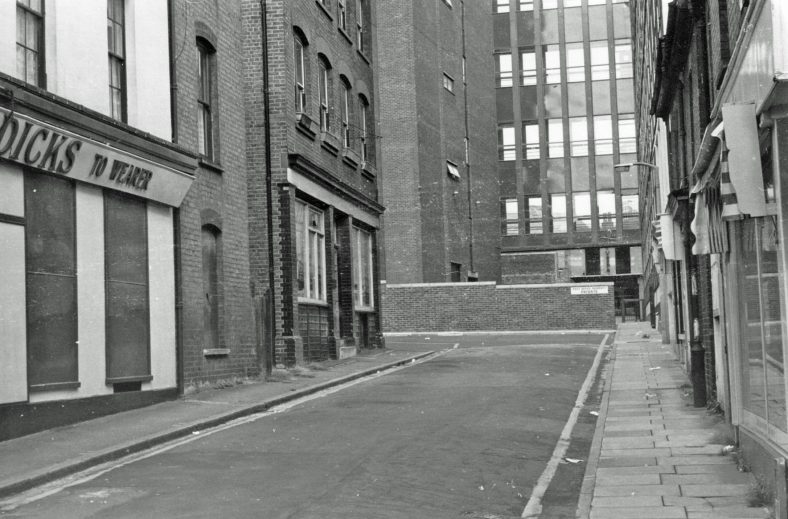
Modern-day Peel Street, associated for many years with police and law-enforcement activities, now a quiet backwater cul-de-sac off Wellington Street, reduced in length and stature by the erection of the Automatic Telephone Exchange seen in the background.
Peel Street, a small cul-de-sac formed by building a new telephone exchange adjoining the old Post Office, originally ran between Dunstable Place and Wellington Street. It was named after Sir Robert Peel, the Home Secretary who established the Metropolitan Police Force in 1829. His ideas on policing were adopted throughout the country and his policy of using the police as a law-keeping force with a separate identity to the military resulted in the introduction of a uniform comprising top hat, frock coat and white trousers. When policemen first appeared on the beat they were nick-named Peelers and later Bobbies after Sir Robert. As a tail-piece to this street, it is on record that, “a small lock-up for detaining miscreants” stood at the corner of Peel Street and Dunstable Place.


A view to St. Mary’s Church past shops and houses under condemnation of demolition, ultimately providing space for The Luton Technical College (remember Europa House?), Youth House, an Overnight Lorry Park and part of Luton’s in-completed Inner Ring Road.


Sunday, September 8th, 1918, one of Luton’s leading businessmen died at the age of 66 after a short illness. Derbyshire-born George Powdrill came to Luton in the 1860s with his family while still in his youth. He built up a business as a builders’ materials merchant, coal merchant, furniture remover and farmer. Here is how The Luton News of September 12th, 1918, recorded his passing:Time as it rolls on carries with it the human tide, and old familiar landmarks in Luton’s business history disappear beneath its ebb and flow. Another familiar figure will today find his resting place, namely Mr George Powdrill, of 7 Crescent Rise, who during the last half century had so successfully built up the business of Powdrill & Sons Ltd.Mr Powdrill passed away on Sunday at the age of 66 years, and he would probably have lived much longer but for the effects of a trap accident several years ago, when his arm was broken. He had never been quite the same man since then, but had been surprisingly active nevertheless. Just over a week ago he was taken seriously ill and succumbed, despite the great care bestowed on him.Mr Powdrill was very young when he came with his father, the late Mr William Powdrill, from Ashby-de-la-Zouch to Bedford. He was engaged with his father in the pottery trade and attended the markets. Later he went to Stopsley and kept on his business. He succeeded, extended his operation, and had a house built for himself by the late Mr J. Saunders in Oxen Lane.Mr Powdrill started the present carting business many years ago, and did a great amount of carting for the father of Alderman H. O. Williams. He was also a keen farmer, and had dairy cows on the Hitchin Road meadow which the site of the present business premises. These he built about 38 years ago, and from that time his business grew in company with the development of the town’s trade. This was due to his sagacity, for practically the whole of his career was given to the business which he managed wonderfully, despite the fact that he was not an educated man, which can be said of many fine businessmen of the old type.His sons, Fred and Arthur Powdrill, joined in the business later, the former being the townsman and the latter taking control of the various farms which Mr Powdrill took over 22 years ago in the parishes surrounding the borough, comprising nearly 2,000 acres.Mr Powdrill added widely but judiciously to his stock of horses, and eventually built large premises in Windmill Road. Just before the war the firm had no fewer than 186 horses.The brickmaking branch was another of several ventures, and again it was most successful, for the excellent quality ensured demands from various parts of the country. He sent a million bricks for the building of the King’s Sanitorium [opened by King Edward VII at Midhurst, Surrey, in 1906, to treat tuberculosis patients].He branched out also in the coal trade and carried out big public contracts, and that, with the builders’ materials branch, became very substantial businesses.He owned a cab business also, and caused a mild sensation by his bringing the first hansom cabs to Luton. At that time the fare from any part of the town was the modest sum of 6d!Mr Powdrill certainly lived a very strenuous life, and in his earlier days he would often journey to London with no more than £10, buy a horse there and ride it home again bare-back to save the cost of the railway journey.As a farmer he bred his own cattle with care and foresight, and every Monday for 20 years his fine animals were to be seen at the Cattle Market. He always had a stock of about 2,000 pigs also.Thus will be seen the outline of his vigorous and painstaking career in business, but this is no more than a bare record of his interests.Mr Powdrill was a Wesleyan Methodist and attended Waller Street from time to time. As a boy he was taught in the Sunday school at Round Green by Mr George Warren.He was never a party politician, and in one election he took his employees to the polling station booths with two of his traction engines, one of which bore the Liberal colours and the other the Conservative colours.Mr Powdrill never aspired to civic positions, but was always keenly interested in local institutions, especially the Bute Hospital, and expressed the wish that his friends would help the hospital rather than send flowers at his funeral.Mr Powdrill at an early age married Miss Tuffnell, daughter of a gentleman well known in the straw trade, and she with her sons and one daughter survive him. [George Powdrill was aged 22 when he married Sarah Tuffnell at St Mary’s Parish Church, Luton, on December 15th, 1873.]About 50 of his employees, some with 35 years service with the firm, attended the funeral at the Church Cemetery, where the service was conducted by the Rev. W. H. Haden, of Union Chapel.[George Powdrill was born at Church Gresley, Derbyshire, near Burton-upon-Trent, in 1851].
My personal memories are of living near his farm and seeing the cows out in the fields from our house.


This photo was taken in the early 1940s, perhaps at Luton Hoo, the home of Sir Harold and Lady Zia Wernher.The photo had to be taken rather quickly before everyone collapsed in laughter. From left to right: Lady Rachel Davidson (Lady in Waiting to the Duchess of Kent), the Marchioness of Milford Haven, Lady Zia Wernher, Georgina Wernher, the Marquess of Milford Haven, Prince Philip of Greece and Denmark, the Duchess of Kent, Sir Harold Wernher, Myra Wernher and an unidentified woman … perhaps Baroness Agnes de Stoeckel. The photo was probably taken before 1944 when Georgina married Harold Phillips.The Marchioness of Milford Haven and Lady Zia were sisters. Georgina and Myra were Sir Harold and Lady Zia’s daughters. Lord Milford Haven and Prince Philip were first cousins. Princess Marina and Prince Philip were also first cousins. The Duchess of Kent and Lady Zia were cousins as well.


2005


The school at Swift’s Green, Stopsley, was opened as a National School in 1858 and taken over by the School Board in 1879. It closed in 1912 and was demolished in 1956.


 LUTON MEMORIES